 Train to Pakistan by Khushwant Singh
My rating: 5 of 5 stars
Mano Majra is a typical pre-independence village in the Indo-Pak border. It is occupied the hardy Punjabis. Some of them are Sikhs and some are Muslims. While there is probably and underlying tension between the two communities there is no explicit animosity. The caretaker of the Gurudwara and the Imam at the Mosque are close friends and enjoy friendly debates along with the motley crowd that they attract.
The village a railway station which becomes a hub of activity whenever a train halts there before crossing over the bridge in to what would become Pakistan or after it crosses over the bridge the other way round. There are very few trains that stop. Most activity goes on in the night when the varied goods trains pass through the darkness one way or the other.
All this changes when the division of India and Pakistan is announced. A local rich Lala is murdered by a gang of dacoits who also loot the riches in his house. A communist comes to stay at the local Gurudwara. A magistrate is sent over to the nearby town of Chundennagar to ensure that there is no trouble in this area.
The book elaborates on the local characters like the son of the dacoit who is having an affair with the young nubile daughter of the Imam, the local inspector of the police who has to make all sorts of arrangements for the magistrate.
Two trains with Hindus massacred in them arrive at the station. The army and the police take control and first time they burn the bodies and the second time they get an earth mover to dig a large grave and bury the dead. The villagers are simmering, refugees from the other side are wanting a revenge and the dacoits are just looking for some action. After a long debate the Muslims of the village are asked to join the refugee camp in Chundennagar. The others promise to take care of their belongings till they return. But much the chagrin and helplessness of the villagers the dacoits and the refugees take over the household vacated by the Muslims.
News trickles in that a train with a load of Muslim refugees is expected to cross over to the the other side in the darkness of the night. The refugees, some of the villagers and dacoits hatch a plan to hack down as many of the refugees as they would pass over the bridge. The son of the dacoit comes to know that the Imam and his daughter would most likely be in the train.
The denouement is the best part of the book. Read the book to enjoy it.
View all my reviews
Showing posts with label Khuswant Singh. Show all posts
Showing posts with label Khuswant Singh. Show all posts
Friday, April 02, 2021
Train to Pakistan by Khuswant Singh


Thursday, October 05, 2017
Gods and Godmen of India by Khuswant Singh
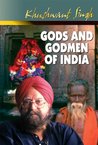 Gods and Godmen of India by Khushwant Singh
My rating: 3 of 5 stars
Kushwant Singh at his irreverent best. The book as the name indicates is about his denunciation of Gods and specifically the numerous godmen in India. He spares none.
In the first section he ridicules the practices like Vaastu and how religion has become a business for many.
The second section is his take on prayers of all types which he believes are humbug.
He reserves most of his words for the last section on godmen. From Dalai Lama to Satya Sai Baba to Chandraswami, he has spared none. He mocks, pokes fun at, ridicules one and all. He has maintained a good relationship with some of them and he is all praise for the discourse of Osho, Rajneesh.
A good read for the agnostics of this world.
View all my reviews
Monday, August 29, 2016
On Love and Sex
 ON LOVE AND SEX by Khushwant Singh
My rating: 3 of 5 stars
A typical Khuswant Singh book more on Sex than on Love.
The last story "Buggered" for a change is a very nice read. The story "A mixed marriage" involving Khwaja Gharib Nawaz is another eminently readable chapter. The rest is as trashy as one can expect from the author.
View all my reviews
Thursday, December 03, 2015
Khushwant Singh Selects Best Indian Short Stories Part II
 Khushwant Singh Selects Best Indian Short Stories. by Khushwant Singh
My rating: 3 of 5 stars
An eclectic collection of short stories from various parts of India. Some of them very good and some not so great.
The ones that appealed to me were as follows:
In "Confessions of a Dustbin" by Karunanidhi the author describes the life from the perspective of a dustbin into which people keep discarding unwanted stuff and it being cleared by the municipality truck. The author shows his atheism and his scoff for religion by speaking about the sexual escapades that the dustbin learns about the Indian Gods from an old book about puranas that somebody has thrown into its belly.
"The Accident" by R. K. Laxman. In this story the author illustrates how a person running away from crime almost crashes into a tree because the papers that he had carelessly thrown in the back seat are stirred up by the air circulating through the car and covers his face preventing him from seeing where he is headed. He uses this trick later to get rid of the goon who has come after him for the spoils.
In "The Palace Orders" by Manohar Malgaonkar speaks about how two people exploit the similarity of a country bumpkin being similar to that of a royalty with a great influence in the country. They use the person to extort money from various people. In the end the country bumpkin tries to double cross them and tries to run away with the extorted money to satisfy his grandfather's dream of flying from his hometown to Delhi by airplane.
In "A Slice of the Melon" by Manohar Malgaonkar describes how unscrupulous persons skim the money that pours into the political party's coffers during the election time. A small time help who sees this happen sets up a front to try and skim some of this money and he almost succeeds.
"Temple Mouse" by Manohar Malgaonkar speaks about how hollow the people are. He describes how a person close to a "spiritual" guru milks his position to make money for himself while another person who is the right hand man of a famous actor does the same.
Both the stories of Sadat Hasan Manto, selected by Khuswant Singh have the element of sexuality in them and this is not surprising given the proclivity of Khushwant Singh for writing stories with at least a tinge sex in them. Did not enjoy either of them, not because of the sex content, but because of the lack of depth.
The author has three stories of his own all obviously reflecting his beliefs and topics close to his heart, that of Agnosticism, bottom pinching and Kama Sutra. The Bottom Pincher and The Agnostic are an OK read, the third is not at all good.
All in all OK read.
View all my reviews
Monday, July 06, 2015
Best Indian Short Stories - Volume 1 by Khushwant Singh
 Best Indian Short Stories - Volume-1 by Khushwant Singh
My rating: 3 of 5 stars
Some of the stories are good while some, in my opinion, are rank bad. The authour seems to like the story teller Qurratulain Hyder very much. There four stories of this writer and for some reason I did not like any of them.
The best story in my opinion was the story A Tale of the hijras by Abdul Jabbar, where a hijra rejected by her parents comes back to her village on the occasion of the birth of a grand child to her mother. How she aspires to go back to live with her parents and how she turns back considering the reaction of the society.
The short story The Leopard by Ruskin Bond is another highlight. He describes how he used to pass through a forest where a leopard lived and how he could here is growling and how on occasions he had, had a glimpse of it. This tranquility is broken when shikaris come to the jungle as the leopard skin sells for 1000 rupees in Delhi. They lay a trap for it and soon hunt it down and triumphantly take it away. As he walks away from the rejoicing shikaris he feels that the whole forest has fallen silent, almost as though the birds and animals knew that their trust had been betrayed. He goes on to say in a very sarcastic way "And God gave Man dominion over the fish of the sea and over the fowl of the air, and over the cattle and over all the earth, and over every creeping thing that creepeth upon the earth". A very sad story which repeats even today, only the scope has increased be it whales hunted by Japan, or seals hunted in Canada, or rhinos and elephants in Africa and India and Tigers in India. Man has no scruples and no heart.
Ramblings on the Beach by Kiran Bedi, yes the very same Kiran Bedi surprisingly made for delightful reading. He speaks about how the society corrupts the children. He says how he tried to bring up his daugther to be brave, not be afraid of the darkness and of the sea. But all this changes when they start going to school where the other children, thanks to the elders in their family, scare his daughter's wits so much that she starts clinging to him telling him about a Buddi Mai who is out to catch the children. He observes how the schools uses fear to make the children behave, fear of ridicule, fear of punishment, fear of humiliation. He observes that the elders do not want children to behave, but only to conform. He observes that bit by bit the elders kill what makes each child distinct from others. He observes that the children are told "all good children go to heaven. And good children are children who think like other good children. The best children, of course, win races and comes first in class. Try to be like them. He also says that he feels sad for his daugther as he can do nothing much for her as he cannot isolate her from the society in which she has to live. He also observes how introverts suffer more in this society. He quotes a Zen poem
Children are Masters of Zen,
Curious about everything.
Adults are serious and boring,
What happened?
Flight 303 by Suresh Chopra is about how a man comes to riches, thanks to his ability to pick locks. It is a fine story with a good twist.
Others are just OK or rank bad.
View all my reviews
Subscribe to:
Posts (Atom)