Showing posts with label Amitav Ghosh. Show all posts

Friday, November 02, 2018

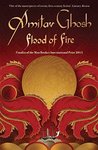
Flood of Fire by Amitava Ghosh

Flood of FireFlood of Fire by Amitav Ghosh
My rating: 4 of 5 stars

Another saga of the Ibis family from the author. The book takes off from the point where the earlier book "Rivers of Smoke".

It primarily traces the life of Kesri Singh, Captain Mee, Neel and Mrs. Shireen Behram Moddie through the first opium war. It traces the history of how the British bulldozed the Chinese to hand over Hong Kong to them and forced them to accept the opium trade through which they made their riches.

Very well presented like the earlier two books. Well researched in terms of how the opium war proceeded.

All seems to end well for the British and the protagonists in the book. Neel unites with this son Raju, Kesri, Neel, Raju, Maddow and Jodu escape on Ibis towards Mauritius. Captain Mee and Mrs. Burnham perish. It looks that Zachary Reid and Paulette would start together on a new life as will Shireen and the Armenian Zadig Bey.

It appears that the author will not take this saga forward, but one wishes that he does.

The book ends with British taking hold of the island of Hong Kong.

A definitely good read. A suggestion read all the three books quickly unless you are of the type who remembers the story and characters for a long period of time.

View all my reviews

Friday, February 24, 2017

The Great Derangement: Climate Change and the Unthinkable by Amitav Ghosh

The Great Derangement: Climate Change and the UnthinkableThe Great Derangement: Climate Change and the Unthinkable by Amitav Ghosh
My rating: 4 of 5 stars

A nice book on environmental damage that we facing today and its consequences. The theme throughout the book is about how the present day novelists do not indulge fantasy and specifically fantasy with regards to natural disasters. (Note that he says that fantasy and science fictions are classified as such and not as novels per se) He says this is one of the reasons why people are not ready to acknowledge the precipice of natural disasters which are to occur because of the global warming.

His push seems to be to the authors to weave the global warming, the disasters expected due it and the solutions, if any, for it in their novels so that the world starts seeing and accepting the disaster they are headed towards. He admits "mea culpa".

The reading of his encounter with the lone tornado to hit New Delhi and his forays into the Andaman and Nicobar immediately after the Tsunami of 2004 is worth reading. They are extremely evocative of the events.

A good read in these days when we are still refusing accept the disasters are waiting to happen. He says that if we do not change our ways then the future will call this "Age of Derangement" when the humans lost their sense and lived in a world of their own fantasy.

View all my reviews

Tuesday, August 16, 2011

The River of Smoke - Amitav Ghosh

River of SmokeRiver of Smoke by Amitav Ghosh

My rating: 4 of 5 stars


Nice book. It continues from where the "Sea of Poppies" leaves us. The book starts at a much later time after the end in "Sea of Poppies". It starts with a description of Deeti and her descendants going to a temple in a remote corner of Mauritius. In this temple Deeti has recorded her travel and experiences from India to Mauritius. Others like Neel and Paulette have also contributed to this. From here it traces the lives of Neel, Ah Fatt, Paulette and Seth Bahram (Ah Fatt's father) from the time at the end of the "Sea of Poppies".
It starts off with how Seth Bahram starts of a poor Parsi living in Navsari in Gujarat and how he comes to marry a rich Parsi's daughter. He then persuades his reluctant father in law to allow him to trade in Opium which is grown in India and is sold in China. The book gives details of how the trade has caused a large population of China to become addicted to it and how the emperor of China is trying to stop its inflow. This is resisted, for obvious reasons, by the British, American and the few Indian traders.
The book goes on to describe how Seth Bahram has set off from Bombay with a large, and hopefully his last, shipment of opium which he has purchased after staking everything that he has. He gets caught in the same storm as Ibis and loses some part of his shipment. By the time he reaches Hongkong the Emperor has managed to shutdown the port of Canton in an attempt to eradicate smuggling of opium into the country. So all the opium importers have to anchor at Hongkong.
In Hongkong Seth meets Ah Fatt his son sired through a Chinese lady in his earlier jaunts to China. The lady in question has died and Ah Fatt has tried to escape to India to meet his father where he is caught committing a crime for which he is sentenced to be transported to Mauritius and that is how he comes to meet Neel.
Neel becomes the Munshi to the Seth as the Seth's Munshi has died because of a trunk falling on his head during the storm. Neel and the Seth travel to Canton in another boat.
In the meantime Paulette meets Mr. Penrose a botanist who is on his way to China to trace a flower of exquisite beauty. He has a painting of this flower which was brought by an earlier botanist. Paulette joins Mr. Penrose on this journey to China and they are anchored at Hongkong too.
Also in parallel an artist from Britain who had run away from his wife in Britain to India had sired two sons through his Indian mistress. This mistress and the mother of Jodu who took care of Paulette happen to live in the same area and are friends. This artist has runaway again from his mistress in India to Canton as no foreign ladies are allowed in Canton. He then shifts to Hongkong and is presently living there. Here he is joined by one of his sons who has been friends of Jodu and Paulette. Mr. Penrose comes in touch with this artist to try and locate the artist who might have painted the flower that he is trying to search and thus Paulette gets back in touch with her childhood friend the son of this artist.
This son then moves to Canton and from here he keeps Paulette updated with the events in Canton through a series of letters.
Now the book moves on to describe the living of the foreign merchants in Canton. It details how the opium is smuggled into the country.
The book goes onto say how these merchants are forced to surrender their opium to the representative of the Chinese emperor who goes on to destroy this opium so that it causes no more problem. In the process Seth Bahram loses all his money and for fear of recrimination from the people from who he has borrowed he commits suicide. The book ends at this point.
It is an engrossing book and loses no steam. It carries on from where the "Sea of Poppies" left off. It looks like the third part would be equally engrossing.
Mr. Amitav Ghosh has managed to hold his audience enthralled.


View all my reviews

Thursday, August 04, 2011

The Sea of Poppies - Amitav Ghosh

Sea of PoppiesSea of Poppies by Amitav Ghosh

My rating: 4 of 5 stars


A nice book that traces the journey of Deeti, The Raja of Rungpur and Paulette Lambert along with a host of other characters out of India. Their journey does not end with the book. Amitav has promised a trilogy so we await the second one.


In the early 19th century Poppy flourished as a trading commodity. It had not yet been outlawed. The British were trying to create a big market in China and poppy was grown in the north of Indian subcontinent.


This is where the story starts. Deeti a simple villager whose village is one of the villages where poppy is grown. There is also a factory where the seeds are processed into a form in which they can be sold. She is forced to marry an old man addicted to hashish and is an incapable lout. She is impregnated by her brother in law in a state of stupor of the hashish smoke which she is forced to inhale and she bears a girl. This section gives a very good description of the times as it was in those days.


When her husband eventually dies her in-laws try to burn her as a sati along with her husband, but she manages to escape with the help of an untouchable. They board a boat going to Calcutta carrying a shipment of indentured labourers bound to Mauritius.


The second story is the story of Raja of Rungpur, near Calcutta who depends on an English merchant and gets cheated out of his money. He is imprisoned for having cheated the merchant and is put along with another criminal of Chinese origin to be shipped to Mauritius. This section has a nice descriptions of the life led by the English men and the Rajas of those days. It also brings to light the blind respect that people had for Rajas and Maharajas.


The third story is tied to the second as the English merchant takes under his care a french girl brought up by an Indian dai (maid-servant) after she is orphaned by her father's death. The mother had died much before it. Her father is a botanist and she loves nature and loves living with it. But at the Englishman's house she finds her freedom restricted and longs to run away. She runs away dressed as a male in the same ship as the others in the story. She is close to the Dai's son who is like a brother to her. This brother also manages to get into the ship to run away from the penury he is facing at home.


The rest of the book is about how the journey progresses. In the meantime Ditee gets pregnant. She is spotted by a villager from her village who tries to take advantage of her and outrage her modesty. The untouchable who is now her husband comes to her rescue and in the process he is caught and is to be punished by death.


They encounter a cyclone in the Bay of Bengal and in the process the Untouchable, the Dai's son, the two "criminals" escape. They take a boat and ride into the cyclone and they are persumed to be dead.


The book ends here.


The description of the places and events evoke a vivid imagery in the reader's mind and Amitav Ghosh has created a masterpiece.


View all my reviews